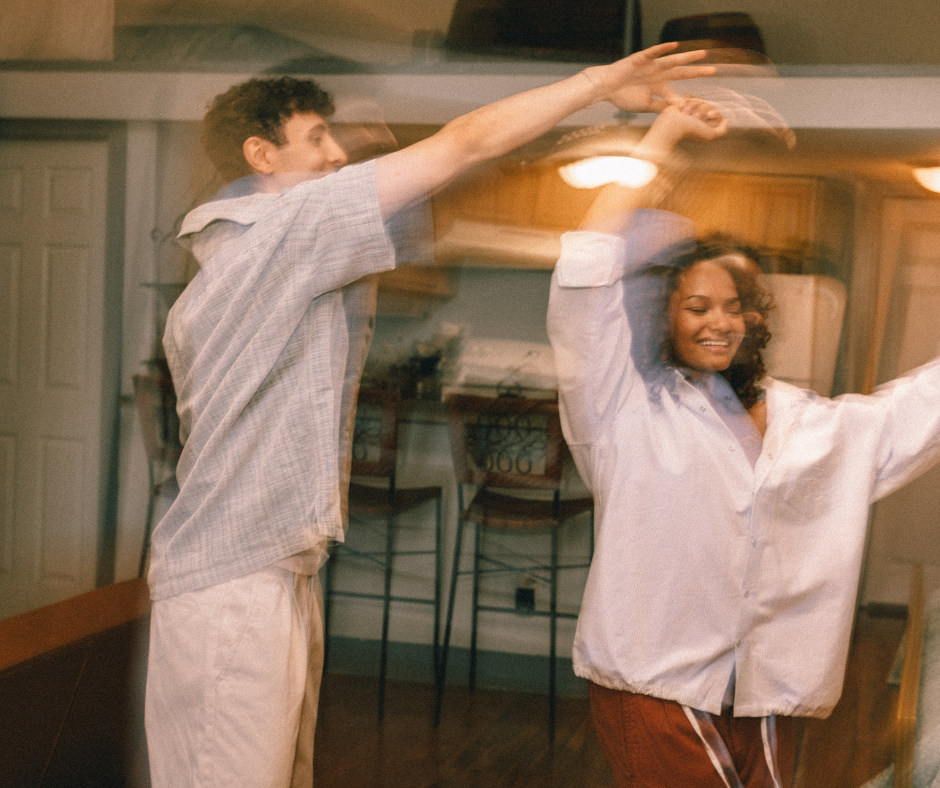
The gap between lessons is where growth happens
Most dancers spend an hour or two per week in lessons and the rest of their time everywhere else. That ratio means your between-lesson practice is where habits actually get built — or don't. The challenge is that home practice without structure easily becomes unfocused repetition, or gets skipped entirely because it doesn't feel "official" enough.
The good news: productive home practice doesn't need to be long, elaborate, or mirror-equipped. It needs to be intentional. Even three focused sessions of 20–30 minutes per week can dramatically accelerate what sticks from your lessons.
First, bust a few myths
Common belief | The reality |
|---|---|
"I need a big space to practice" | Most fundamentals — footwork, posture, timing, arm styling — need almost no floor space at all. |
"Practicing alone doesn't help if I need a partner" | Solo practice is where you own your own technique. Your partner can't do that work for you. |
"I should run the whole routine every time" | Isolating one 8-count section and doing it well is worth far more than a sloppy full run-through. |
Structure your sessions with a simple framework
Think of each practice session in three layers:
Layer 1 — Body prep (5 min): Posture, frame, weight placement — get into dance shape before you move
Layer 2 — Focused drilling (15 min): One pattern, one technique detail, one transition — worked slowly and precisely
Layer 3 — Musicality pass (10 min): Put on your music and dance through what you know — feel it, don't just execute it
The 30-minute rule: If you only have 30 minutes, spend 20 on Layer 2 and 10 on Layer 3. Never skip Layer 3 — ending on musicality keeps the joy in practice.
What to actually practice at home
After each lesson, write down one to three specific things your teacher corrected or introduced. Those notes become your home practice agenda for the week. Beyond lesson notes, solo practice is especially effective for:
Footwork patterns — walk through them slowly without music, feeling each weight transfer
Body posture and frame — stand in your dance position for 60 seconds, notice what tires first
Timing and rhythm — clap, walk, or step to music without doing any choreography at all
Arm and hand styling — stand still and work through arm movements in a mirror or on video
Mental run-throughs — sit down, close your eyes, and choreograph your routine in your head
On mental rehearsal: Research in motor learning consistently shows that mental practice — vividly imagining movement — activates the same neural pathways as physical practice. It's especially useful the day before a lesson or competition.
Building the habit, not just the session
Attach practice to something you already do. Put your practice shoes by your coffee maker. Run through your basic step while waiting for the shower to warm up. Lowering the activation cost makes it far easier to start.
Keep a simple practice log — just a note on your phone. Writing "Worked on natural turn, still rushing the third step"takes ten seconds and gives you a thread to pick up next session.
The mindset that makes it all work
Home practice works best when you treat it as a conversation with what you learned in your last lesson — not as a performance, and not as a test. You're not trying to get it perfect. You're trying to deepen your understanding of it, one repetition at a time.
The dancers who improve fastest between lessons aren't the most naturally talented. They're the ones who stay curious about the details, who practice slowly enough to feel what's happening, and who show up for ten minutes on a Tuesday even when they don't feel like it.
That's the habit. The technique follows.
"You don't rise to the level of your lessons. You fall to the level of your practice."