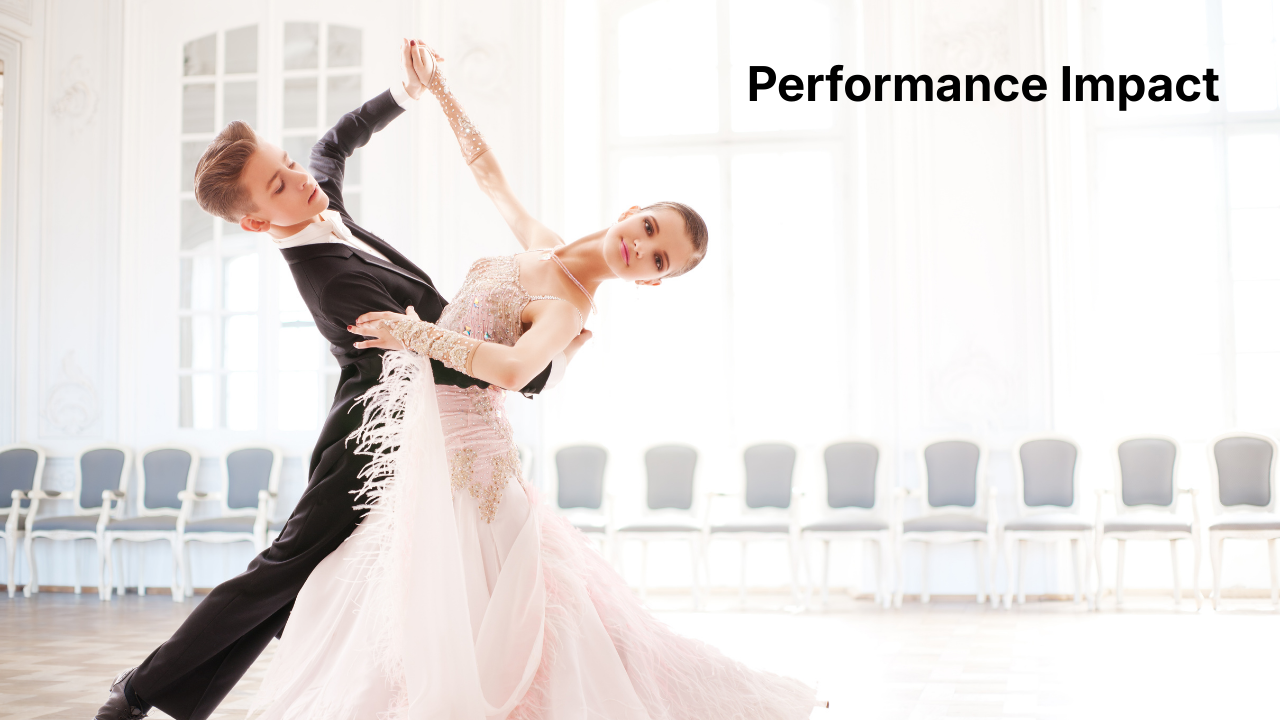
You know your choreography perfectly. Your technique is solid. Your timing is accurate. But when you watch your competition video, something crucial is missing—you look like you're executing choreography rather than performing a dance. Your face is concentrated and serious. Your energy stays internal. You're dancing correctly but not compellingly.
Judges watching thirty couples on a crowded floor notice dancers who command attention—not just those who execute technique correctly. The couple with slightly weaker footwork but powerful stage presence often places higher than technically superior couples who fade into the background. Performance impact—the ability to engage judges and audience emotionally—frequently determines placements more than marginal technical differences.
The frustrating part: nobody teaches performance. Your coach works on frame, footwork, and rise and fall. You practice technique diligently. But the crucial element that separates competent dancing from compelling performance? That often gets overlooked until you're wondering why your placements don't reflect the technical work you've invested.
Here's the surprising truth: performance impact is one of the easiest elements to improve through online video coaching. Unlike subtle technical issues requiring hands-on correction, performance problems show up glaringly obvious on video—and the corrections are largely about awareness and intentional choices you can implement immediately.
The Performance Gap: What Video Reveals
Most dancers are genuinely shocked when they first watch themselves perform. The internal experience of dancing—feeling the music, enjoying the movement, connecting with your partner—feels emotionally rich and expressive from inside. Then you watch the video and see... nothing. Your face looks blank or concentrated. Your energy looks contained. The emotional experience you were having internally didn't translate outward at all.
This is the performance gap: the massive difference between what performing feels like and what it looks like to outside observers.
Professional performers understand this gap intuitively and consciously bridge it—they make deliberate choices about facial expression, eye focus, and energy projection that communicate to audience even when they're not feeling particularly inspired internally. Amateur dancers assume that feeling the music deeply will automatically translate to looking musical. It doesn't.
Video coaching excels at revealing this gap because it shows you exactly what judges and audience see—not what you feel or intend, but what's actually visible.
Diagnosing Your Performance Problems Through Video
Before you can fix performance issues, you need accurate diagnosis of which specific problems are limiting your impact. Record a full routine and watch it specifically for performance elements—not technique. Pretend you're a judge who knows nothing about you, seeing you for the first time on a crowded competitive floor.
Energy Level and Projection
Does your energy project outward into the room or stay internal and contained? Dancers with strong performance impact look like they're filling the space—their movement quality, body language, and presence extend beyond their physical bodies. Dancers lacking impact look like they're dancing inside a small bubble that doesn't extend beyond arm's length.
Watch your video and assess honestly: would you notice yourself on a crowded floor? If twelve couples are dancing simultaneously, does your energy level command attention or blend into the background?
Common energy problems visible on video: movement that looks tentative or held back, upper body that looks stiff or constrained, facial expression that communicates concentration or anxiety rather than enjoyment, and overall quality that reads as "practicing" rather than "performing."
Facial Expression and Eye Focus
Your face communicates more about your dancing than almost any other single element—and most dancers have no idea what their face is doing while they dance.
Watch your competition footage focusing exclusively on your facial expression. What story does your face tell? Common problems: blank, neutral expression throughout the entire routine, concentrated frown showing you're thinking about technique, eyes looking down at the floor or at your partner's shoulder, tense jaw or strained neck visible in your face, and expression that never changes regardless of the dance's musical character.
Strong performers show facial expressions that match the dance character—romantic and flowing for waltz, playful or dramatic for Latin, sophisticated for foxtrot. Their expressions evolve through the routine rather than staying frozen. Their eyes engage outward—toward audience, judges, or an imagined horizon—rather than looking down or inward.
Musical Interpretation and Character
Does your dancing look different between waltz and foxtrot, rumba and cha cha? Or do you execute different choreography with essentially identical movement quality?
Performance impact requires embodying the distinct character of each dance—not just knowing different steps but genuinely inhabiting different emotional and physical qualities. Watch videos of yourself dancing multiple dances and assess whether each looks recognizably different in character or whether they all look like generic "ballroom dancing" at different tempos.
Common character problems: all dances performed with similar energy level and quality, no variation in facial expression between romantic waltz and dramatic tango, movement quality that doesn't reflect musical phrasing or accents, and dancing that looks the same to any music versus responding to specific musical qualities.
Connection With Partner and Audience
Are you dancing with your partner or near your partner? Strong partnership chemistry shows in how couples relate to each other—occasional eye contact, responsive body language, moments of genuine connection that transcend technical execution.
Do you acknowledge that audience and judges exist? Dancers with strong performance awareness engage outward. They might make brief eye contact with judges or project energy toward audience. They perform for the room, not just for themselves.
Watch your video and note: do you and your partner ever look at each other beyond starting position? Does your performance acknowledge that anyone is watching? Or are you completely self-contained in your own technical execution bubble?
Specific Corrections You Can Implement Solo
Unlike many technical problems requiring partner practice, performance improvements can largely be developed individually and then integrated into partnership dancing.
Fix 1: Conscious Facial Expression Practice
Stand in front of a mirror and practice the facial expressions appropriate for each dance you perform. Not exaggerated stage mugging—natural expressions that communicate the dance character.
Waltz: soft, romantic, slightly dreamy expression. Gentle smile, relaxed jaw, eyes that look slightly upward or toward the horizon rather than down.
Foxtrot: sophisticated, elegant, confident expression. Subtle smile, poised bearing, eyes engaged forward.
Tango: intense, dramatic, focused expression. Strong eye line, engaged face without tension, powerful presence.
Latin/Rhythm: varies by dance—playful for cha cha, sensual for rumba, joyful for samba. Higher energy in the face, more dynamic expression.
Practice these expressions while standing still first, then while walking through your choreography, then while dancing full routine. Record yourself and watch specifically for whether the facial expression you practiced is actually visible on video.
The key insight: what feels like exaggerated expression to you usually reads as appropriately expressive on video. What feels natural and subtle to you usually reads as blank or neutral. You need to amplify beyond what feels comfortable initially to achieve what looks appropriate on camera and to judges at distance.
Fix 2: Energy Amplification Exercise
Your current energy level feels normal to you because it's habitual. To improve performance impact, you need to deliberately practice dancing at higher energy levels than feel natural.
Record yourself dancing a routine at what feels like your normal energy—this is your baseline. Then record the same routine at what feels like 150% energy—amped up to a level that feels uncomfortably high, almost ridiculous. Then watch both videos.
Most dancers discover that 150% internal energy reads as appropriately dynamic energy on video, while "normal" energy looks low and contained. The discomfort you feel performing at higher energy is simply unfamiliarity—it's not actually inappropriate, it just feels strange because it's different from your habit.
Practice deliberately at this higher energy level until it becomes your new normal. Record regularly to verify the energy level is translating visually, not just feeling different internally.
Fix 3: Eye Focus Discipline
Your eyes communicate presence and engagement more powerfully than almost anything else. Most dancers have habitual eye focus patterns they're completely unaware of—usually looking down at the floor or at their partner's shoulder.
Practice deliberate eye focus while dancing:
Forward and outward: Eyes engage forward into the room, slightly above audience head-level, creating impression of dancing for the room rather than for yourself.
Occasional partner acknowledgment: Brief moments of eye contact with your partner during the routine—not constant staring but occasional connection that shows genuine partnership.
Never down: The floor has nothing interesting on it. Eyes looking down communicates anxiety, lack of confidence, or excessive concentration on feet. Unless there's specific choreographic reason (rare), your eyes should stay at or above horizon level.
Record yourself dancing while consciously maintaining this eye discipline. Watch the video specifically for eye focus—you'll likely discover your eyes still drop to the floor more than you realized. Continue practicing until forward/outward eye focus becomes automatic.
Fix 4: Musical Interpretation and Accenting
Generic, metronomic dancing—moving exactly the same way regardless of musical phrasing or accents—looks robotic and fails to engage emotionally. Musical interpretation creates performance impact.
Listen to your competition music repeatedly away from dancing. Identify: where are the musical phrases? Where are the crescendos? Where are the accents or highlights? What's the emotional quality of this specific piece of music?
Then practice dancing your choreography while consciously responding to these musical elements. Subtle speed variations through phrases, slightly larger movement on musical accents, body energy that swells and retreats with the music's dynamics. You're not changing choreography—you're letting the music influence how you execute the same steps.
Record yourself dancing with conscious musical interpretation versus dancing the same routine metronomically. The difference in visual engagement is dramatic. The musically interpreted version commands attention even when technique is identical.
Fix 5: Performance Mode vs. Practice Mode
Many dancers practice in "technical execution mode"—focused internally on correctness, mechanics, and problem-solving. Then they compete in that same mode, wondering why their performance lacks impact.
Develop a distinct "performance mode" you activate for run-throughs and competitions: facial expression on, energy amplified, eyes engaged outward, musical interpretation active, performing for audience rather than practicing technique.
The mental shift from "executing correctly" to "sharing a performance" creates visible transformation in your dancing. Practice activating performance mode deliberately—don't wait until competition to try it. Record yourself in both modes and watch the difference.
Initially, performance mode will feel like you're sacrificing technical focus. With practice, it becomes integrated—you can maintain technical quality while projecting performance energy simultaneously. But you must practice it deliberately, not hope it magically appears in competition when you've only ever practiced in technical mode.
Working With Online Coaches on Performance
Video coaches excel at identifying performance problems because they're glaringly visible on video. When submitting footage for performance-focused coaching, provide context:
"I'd like feedback specifically on performance quality and stage presence. I know my technique has issues but this submission is about whether I'm engaging as a performer or fading into the background. I want honest assessment of facial expression, energy projection, and musical interpretation."
This focus helps coaches provide targeted feedback on performance elements rather than spending entire critique on technical corrections.
Coaches can identify specific moments where performance drops: "Your energy is strong through the first minute but fades noticeably from 1:15 onward—you shift from performing to concentrating on technique." "Your facial expression is engaged during waltz but becomes blank during the natural turn sequence—you're thinking about footwork and it shows in your face."
These specific observations help you practice fixing performance at exact moments rather than vaguely trying to "perform better overall."
Competition Footage Analysis
If you've already competed and have footage, this is gold for performance analysis. Competition footage shows your authentic performance under pressure—not how you perform in practice but how you actually show up when it matters.
Watch your competition footage alongside practice videos of the same routines. Where does performance quality drop in competition versus practice? Common patterns: energy decreases when tired or nervous, facial expression becomes tense under pressure, eye focus drops to the floor when concentration increases, musical interpretation disappears as technical anxiety takes over.
Identifying these patterns helps you practice specifically for competition pressure—deliberately maintaining performance quality when you're tired, keeping facial expression engaged when you're nervous, sustaining energy through entire routines rather than letting it fade.
The Practice Process
Improving performance impact through video coaching follows a specific cycle:
Week 1: Record baseline video showing current performance quality. Submit for coaching with specific performance-focus request.
Week 2: Receive coaching identifying specific performance problems—energy level, facial expression, eye focus, musical interpretation issues.
Weeks 3-4: Practice corrections deliberately, recording yourself regularly to verify changes are visible on video. Focus on one or two elements rather than fixing everything simultaneously.
Week 5: Record new video showing implementation of corrections. Submit for follow-up coaching to verify improvement and identify next priority.
Week 6: Continue refining based on follow-up feedback.
This iterative process with video documentation creates measurable performance improvement across 4-6 weeks—much faster than typical technical corrections require.
Why This Works Without In-Person Coaching
Performance coaching doesn't require hands-on physical adjustment or kinesthetic feedback. It requires seeing what you look like to outside observers and making conscious choices about what you project.
In-person coaches can tell you "project more energy" but can't make you feel what that looks like. Video coaching shows you exactly what "more energy" looks like on your own body, in your own dancing, creating concrete visual target rather than abstract instruction.
The feedback loop—record, watch, adjust, record again—provides immediate verification of whether your adjustments are working. You're not guessing or hoping; you're seeing the actual result of your performance choices.
Additionally, many performance corrections feel uncomfortable initially because they require breaking habitual patterns. Working independently through video coaching lets you practice these uncomfortable new patterns without the self-consciousness of trying them in front of a coach or in group class settings.
The Transformation Timeline
Most dancers see noticeable performance improvement within 2-3 practice weeks of focused work with video feedback. Unlike technical corrections requiring muscle memory reprogramming across months, performance changes are largely conscious choices that can be implemented immediately once you're aware of them.
The challenge isn't the difficulty of improvement—it's the awareness that improvement is needed. Most dancers don't realize their performance impact is low until they see themselves on video with honest eyes. Once awareness exists, the corrections are relatively straightforward.
After 6-8 weeks of deliberate performance practice with video coaching: your energy level on video reflects your internal experience more accurately, your facial expression communicates the dance character appropriately, your eyes engage outward rather than looking down, and your overall presence commands attention rather than blending into the background.
Judges notice this transformation immediately. The couple who faded into the floor at the last competition suddenly stands out—not because their technique improved dramatically in six weeks, but because they're finally performing rather than just executing.
Beyond the Basics: Advanced Performance Development
Once you've addressed fundamental performance issues—energy level, facial expression, eye focus, musical interpretation—more nuanced performance development becomes possible.
Partnership chemistry requires both partners developing performance awareness simultaneously. Chemistry shows when both partners are performing outward rather than concentrating inward, when occasional eye contact or responsive body language reveals genuine connection, and when the couple appears to be dancing together rather than executing choreography in proximity.
Signature moments—specific powerful positions, musical highlights, or expressive moments that characterize your dancing—create memorable impressions that generic correct execution never achieves. Video coaching helps identify where these moments could exist in your choreography and how to maximize their impact.
Performance sustainability—maintaining full performance energy through entire routines and across multiple dances in competition rounds—requires specific practice that video coaching helps develop by revealing exactly where and when your performance energy drops.
Your Performance Future
Technical training dominates most dancers' practice focus because it's concrete and measurable—your footwork is either correct or incorrect. Performance quality feels subjective and vague, so it gets deprioritized or ignored completely.
This is backwards. Judges evaluate both technical quality and performance impact. Couples with adequate technique and strong performance regularly place higher than couples with superior technique and weak performance. Yet dancers invest 90% of practice time on technique and essentially zero time on performance.
Video coaching makes performance development concrete and measurable. You can see whether your energy projects or stays contained. You can watch whether your facial expression communicates appropriately. You can verify whether you engage outward or look down at the floor. These aren't subjective guesses—they're visible facts on video.
Start recording yourself specifically for performance assessment. Submit footage to coaches with explicit performance-focus requests. Practice the conscious performance choices that transform competent dancing into compelling performance.
The technical work you've invested deserves to be seen. Performance impact ensures it doesn't fade invisibly into the competitive floor. And video coaching provides the exact tool you need to develop it—without requiring in-person lessons, without complex technical corrections, often with faster visible improvement than technical work produces.
Your next competition: judges won't just see you executing choreography. They'll see you performing—and they'll remember you.